Control statements
So far we have discussed:
- Expressions, including function calls
- Assignments
- Augmented assignments
- Various forms of
import - Assertions
returnyield(to implement generators)pass- statements:
def- for defining functionswith- to use with files
We will discuss about compound statements:
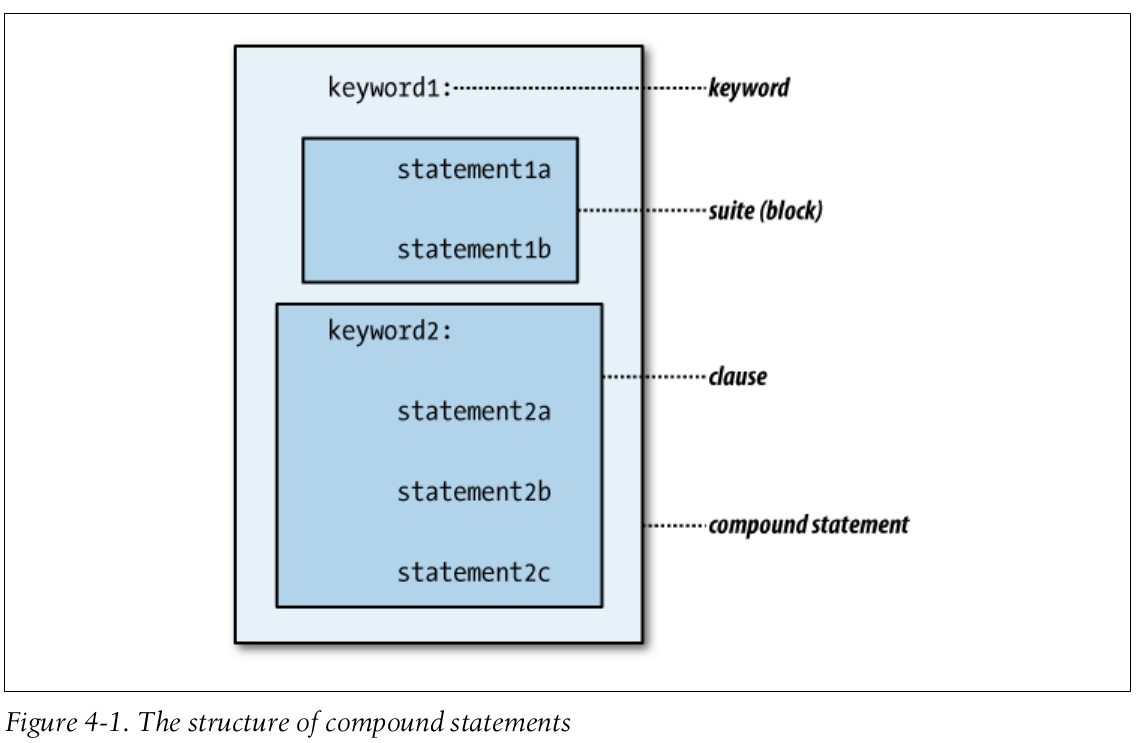
The four kinds of compound statements introduced here are:
- Conditionals
- Loops
- Iterations
- Exception handlers
Conditionals
Conditionals in Python are compound statements beginning with if.
if expression:
      statements
- During the import of a module
__name__is bound to the name of the module, but while the file is being executed__name__is bound to '__main__' . - This gives you a way to include statements in your Python files that are executed only when the module is run or, conversely, only when it is imported.
def do_tests():
    pass

if __name__ == '__main__':
    do_tests()
One-Alternative Conditionals
if expression:
       statements1
else:
     statements2
if __name__ == '__main__':
    do_tests()
else:
    print(__name__,'has been imported')
Multi-Test Conditionals
if expression1:
       statements1
elif expression2:
    statements2
    ...any number of additional elif clauses
else:
    statements
Loops
A loop is a block of statements that gets executed as long as some condition is true. Statements get executed if the test expresssion is satisfied.
    while expression:
statements- If code is to be execute once the test expression is false
  while expression:
      statements1
  else:
      statments2
- Two simple statements associated eith loops and iterations:
continueandbreak - The
continuestatement causes execution of the loop to return to the test. - The
breakstatement interrupts the entire loop’s execution, causing the program to continue with the statement following the while .
def echo():
    """Echo the user's input until an empty line is entered"""
    while echo1():
        pass

def echo1():
    """Prompt the user for a string, "echo" it, and return it"""
    line = input('Say something: ')
    print('You said "', line, '"', sep='')
    return line

echo()
def polite_echo():
    """Echo the user's input until it equals 'bye'"""
    while echo1() != 'bye':
        pass


polite_echo()
def recording_echo():
    """Echo the user's input until it equals 'bye', then return a
    list of all the inputs received"""
    lst = []                 # initialize entry and lst
    entry = echo1()          # get the first input
    while entry != 'bye':    # test entry
        lst.append(entry)    # use entry
        entry = echo1()      # change entry
        # ... repeat
    return lst               # return result

recording_echo()
Looping forever
initialize values
while True:
    # change values
    if test values:
        return
    use values
    # repeat
return resultdef recording_echo_with_conditional():
"""Echo the user's input until it equals 'bye', then return a
list of all the inputs received"""
seq = []
# no need to initialize a value to be tested since nothing is tested!
while True:
entry = echo1()
if entry == 'bye':
return seq
seq.append(entry)
recording_echo_with_conditional()
RNA_codon_table = {
#                        Second Base
#        U             C             A             G
# U
    'UUU': 'Phe', 'UCU': 'Ser', 'UAU': 'Tyr', 'UGU': 'Cys',     # UxU
    'UUC': 'Phe', 'UCC': 'Ser', 'UAC': 'Tyr', 'UGC': 'Cys',     # UxC
    'UUA': 'Leu', 'UCA': 'Ser', 'UAA': '---', 'UGA': '---',     # UxA
    'UUG': 'Leu', 'UCG': 'Ser', 'UAG': '---', 'UGG': 'Urp',     # UxG
# C
    'CUU': 'Leu', 'CCU': 'Pro', 'CAU': 'His', 'CGU': 'Arg',     # CxU
    'CUC': 'Leu', 'CCC': 'Pro', 'CAC': 'His', 'CGC': 'Arg',     # CxC
    'CUA': 'Leu', 'CCA': 'Pro', 'CAA': 'Gln', 'CGA': 'Arg',     # CxA
    'CUG': 'Leu', 'CCG': 'Pro', 'CAG': 'Gln', 'CGG': 'Arg',     # CxG
# A
    'AUU': 'Ile', 'ACU': 'Thr', 'AAU': 'Asn', 'AGU': 'Ser',     # AxU
    'AUC': 'Ile', 'ACC': 'Thr', 'AAC': 'Asn', 'AGC': 'Ser',     # AxC
    'AUA': 'Ile', 'ACA': 'Thr', 'AAA': 'Lys', 'AGA': 'Arg',     # AxA
    'AUG': 'Met', 'ACG': 'Thr', 'AAG': 'Lys', 'AGG': 'Arg',     # AxG
# G
    'GUU': 'Val', 'GCU': 'Ala', 'GAU': 'Asp', 'GGU': 'Gly',     # GxU
    'GUC': 'Val', 'GCC': 'Ala', 'GAC': 'Asp', 'GGC': 'Gly',     # GxC
    'GUA': 'Val', 'GCA': 'Ala', 'GAA': 'Glu', 'GGA': 'Gly',     # GxA
    'GUG': 'Val', 'GCG': 'Ala', 'GAG': 'Glu', 'GGG': 'Gly'      # GxG
}


def translate_RNA_codon(codon):
    """RNA codon lookup from a dictionary"""
    return RNA_codon_table[codon]

def aa_generator(rnaseq):
    """Return a generator object that produces an amino acid by
    translating the next three characters of rnaseq each time next is
    called on it"""
    return (translate_RNA_codon(rnaseq[n:n+3])
            for n in range(0, len(rnaseq), 3))

def translate(rnaseq):
    """Translate rnaseq into amino acid symbols"""
    gen = aa_generator(rnaseq)
    seq = ''
    aa = next(gen, None)
    while aa:
        seq += aa
        aa = next(gen, None)
    return seq

translate('AAUAAGCGCGGGUAUGAUGCGGUCUUG')
def read_sequence(filename):
    """Given the name of a FASTA file named filename, read and return
    its first sequence, ignoring the sequence's description"""
    seq = ''
    with open(filename) as file:
        line = file.readline()
        while line and line[0] == '>':
            line = file.readline()
        while line and line[0] != '>':      # must check for end of file
            seq += line
            line = file.readline()
    return seq

read_sequence('data/aa003.fasta')
Iterations
- Doing something to each element of a collection is called iteration.
- Iteration statements all begin with the keyword
for.for item in collection: do something with item
File Iteration
with open(filename) as file:
    for line in file:
        do something with line
Dictionary Iteration
for key in dictionary.keys():
    do something with key
for key in dictionary.values():
do something with valuefor key, value in dictionary.items():
do something with key and valueNumbering Iterations
Use the function enumerate and tuple unpacking to generate numerical keys in parallel with the values in an iterable.
for n, value in enumerate(iterable):
do something with n and valuea = list(range(10,20))
for n, value in enumerate(a):
print(n, value, sep='\t')
def print_collection(collection):
    for item in collection:
        print(item)
    print()
collection = [2, 3, 4, 5]
[print(item) for item in collection]
Repeat - Template
To repeat a block of statements n times, iterate over range(n).
for count in range(n):
    statements
Frequently, count would not even be used in the body of the iteration.
Collect - Template
- A Collect iteration starts with an empty collection and uses a method or operator appropriate to its type to add something to it for each iteration.
result = []
for item in collection:
  statements using item
  result.append(expression based on the statements)
return result
#Reading FASTA entries with a Collect iteration

def read_FASTA_iteration(filename):
    sequences = []
    descr = None
    with open(filename) as file:
        for line in file:
            if line[0] == '>':
                if descr:                               # have we found one yet?
                    sequences.append((descr, seq))
                descr = line[1:-1].split('|')
                seq = ''                                # start a new sequence
            else:
                seq += line[:-1]
        sequences.append((descr, seq))                  # add the last one found
    return sequences

def read_FASTA(filename):
    with open(filename) as file:
        return [(part[0].split('|'),
                 part[2].replace('\n', ''))
                for part in
                [entry.partition('\n')
                 for entry in file.read().split('>')[1:]]]

def read_FASTA_loop(filename):
    sequences = []
    descr = None
    with open(filename) as file:
        line = file.readline()[:-1]                     # always trim newline
        while line:
            if line[0] == '>':
                if descr:                               # any sequence found yet?
                    sequences.append((descr, seq))
                descr = line[1:].split('|')
                seq = ''                                # start a new sequence
            else:
                seq += line
            line = file.readline()[:-1]
        sequences.append((descr, seq))                  # easy to forget!
    return sequences


def test():
    filename = 'data/aa003.fasta'
    result1 = read_FASTA_iteration(filename)
    result2 = read_FASTA(filename)
    result3 = read_FASTA_loop(filename)
    assert result1 == result2 == result3
    print('All tests passed')
test()
Combine - Template
- Sometimes we want to perform an operation on all of the elements of a collection to yield a single value.
def product(coll):
    """Return the product of the elements of coll converted to floats, including elements that
    are string representations of numbers; if coll has an element that is a string but doesn't
    represent a number, an error will occur"""
    result = 1.0                                        # initialize
    for elt in coll:
        result *= float(elt)                            # combine element with
    return result                                       # accumulated result

product(range(1, 6))
### Combine: identifying the longest FASTA sequence

def longest_sequence(filename):
    longest_seq = ''
    for info, seq in read_FASTA(filename):
        longest_seq = max(longest_seq, seq, key=len)
    return longest_seq

longest_sequence('data/aa003.fasta')
Count
- A Count iteration “combines” the value 1 for each element of the iteration.
count = 0
for item in iterable:
  count += 1
return count
Collection Combine
- In this variation on Combine, an action is performed on each element of a collection that produces a collection as a result, but instead of returning a collection of the results, the iteration combines the results into (reduces the results to) a single collection.
result = []
for item in collection:
  result += fn(item)
  # merge result with previous results
return result
### Collection Combine: sequence IDs from multiple files

def extract_gi_id(description):
    """Given a FASTA file description line, return its GenInfo ID if it has one"""
    if description[0] != '>':
        return None
    fields = description[1:].split('|')
    if 'gi' not in fields:
        return None
    return fields[1 + fields.index('gi')]

def get_gi_ids(filename):
    """Return a list of the GenInfo IDs of all sequences found in the file named filename"""
    with open(filename) as file:
        return [extract_gi_id(line) for line in file if line[0] == '>']

def get_gi_ids_from_files(filenames):
    """Return a list of the GenInfo IDs of all sequences found in the files whose names are
    contained in the collection filenames"""
    idlst = []
    for filename in filenames:
        idlst += get_gi_ids(filename)
    return idlst

def test():
    filenames = ('data/nadh.fasta',
                 'data/aa003.fasta',
                 'data/BacillusSubtilisPlastmidP1414.fasta'
                 )
    print(get_gi_ids_from_files(filenames))
test()
Search
- Search is a simple variation on Do:
for item in collection:
  if test item:
      return item
### Extracting a sequence by ID from a large FASTA file

def FASTA_search_by_gi_id(id, file):
    for line in file:
        if (line[0] == '>' and str(id) == get_gi_id(line)):
            return read_FASTA_sequence(file)

def search_FASTA_file_by_gi_id(id, filename):
    """Return the sequence with the GenInfo ID ID from the FASTA file
    named filename, reading one entry at a time until it is found"""
    id = str(id)                      # user might call with a number
    with open(filename) as file:
        return FASTA_search_by_gi_id(id, file)

def read_FASTA_sequence(file):
    seq = ''
    for line in file:
        if not line or line[0] == '>':
            return seq
        seq += line[:-1]

def get_gi_id(description):
    fields = description[1:].split('|')
    if fields and 'gi' in fields:
        return fields[(1 + fields.index('gi'))]

filename = 'data/Acidobacterium-capsulatum-coding-regions.fasta'
search_FASTA_file_by_gi_id('225793573', filename)
def rna_sequence_is_valid(seq):
    for base in seq:
        if base not in 'UCAGucag':
            return False
    return True

def dna_sequence_contains_N(seq):
    for base in seq:
        if base == 'N':
            return True
Filter
Filtering is similar to searching, but instead of returning a result the first time a match is found, it does something with each element for which the match was successful.
Filtered Do
- A Filtered Do performs an action for each item that meets a specified condition.
for item in collection:
  if test item:
      statements using item
### Printing the header lines from a FASTA file

def print_FASTA_headers(filename):
    with open(filename) as file:
        for line in file:
            if line[0] == '>':
                print(line[1:-1])

print_FASTA_headers('data/aa010.fasta')
Filtered Collect
- Here, the values for which test is true are collected one at a time.
result = []
for item in collection:
   if test item:
       statements using item
       result.append(expression based on the statements)
return result
### Extracting sequences with matching descriptions

def extract_matching_sequences(filename, string):
    """From a FASTA file named filename, extract all sequences whose descriptions contain string"""
    sequences = []
    seq = ''
    with open(filename) as file:
        for line in file:
            if line[0] == '>':
                if seq:                        # not first time through
                    sequences.append(seq)
                seq = ''                       # next sequence detected
                includeflag = string in line   # flag for later iterations
            else:
                if includeflag:
                    seq += line[:-1]
        if seq:                        # last sequence in file is included
            sequences.append(seq)
    return sequences

for seq in extract_matching_sequences('data/aa010.fasta', 'factor'):
    print(seq)
Filtered Combine
### Filtered Combine: another definition of product

def is_number(value):
    """Return True if value is an int or a float"""
    return isinstance(value, int) or isinstance(value, float)

def product(coll):
    """Return the product of the numeric elements of coll"""
    result = 1.0                         # initialize
    for elt in coll:
        if is_number(elt):
            result = result * float(elt) # combine element with accumulated result
    return result

product((2, None, 3.5, 'four'))
Filtered Count
count = 0
for item in iterable:
    if test item:
        count += 1
return count
Nested Iterations
for outer in outer_collection:
    for inner in inner_collection:
do something with inner and outer### A nested iteration
def list_sequences_in_files(filelist):
"""For each file whose name is contained in filelist, list the
description of each sequence it contains"""
for filename in filelist:
print(filename)
with open(filename) as file:
for line in file:
if line[0] == '>':
print('\t', line[1:-1])
filenames = ('data/nadh.fasta',
'data/aa003.fasta',
'data/BacillusSubtilisPlastmidP1414.fasta'
)
list_sequences_in_files(filenames)
### A two-function nested iteration

def list_sequences_in_files(filelist):
    """For each file whose name is contained in filelist, list the
    description of each sequence it contains"""
    for filename in filelist:
        print(filename)
        with open(filename) as file:
            list_sequences_in_file(file)

def list_sequences_in_file(file):
    for line in file:
        if line[0] == '>':
            print('\t', line[1:-1])


filenames = ('data/nadh.fasta',
             'data/aa003.fasta',
             'data/BacillusSubtilisPlastmidP1414.fasta'
            )
list_sequences_in_filesb(filenames)
### Printing the codon table

RNA_codon_table = {
#                        Second Base
#        U             C             A             G
# U
    'UUU': 'Phe', 'UCU': 'Ser', 'UAU': 'Tyr', 'UGU': 'Cys',     # UxU
    'UUC': 'Phe', 'UCC': 'Ser', 'UAC': 'Tyr', 'UGC': 'Cys',     # UxC
    'UUA': 'Leu', 'UCA': 'Ser', 'UAA': '---', 'UGA': '---',     # UxA
    'UUG': 'Leu', 'UCG': 'Ser', 'UAG': '---', 'UGG': 'Urp',     # UxG
# C
    'CUU': 'Leu', 'CCU': 'Pro', 'CAU': 'His', 'CGU': 'Arg',     # CxU
    'CUC': 'Leu', 'CCC': 'Pro', 'CAC': 'His', 'CGC': 'Arg',     # CxC
    'CUA': 'Leu', 'CCA': 'Pro', 'CAA': 'Gln', 'CGA': 'Arg',     # CxA
    'CUG': 'Leu', 'CCG': 'Pro', 'CAG': 'Gln', 'CGG': 'Arg',     # CxG
# A
    'AUU': 'Ile', 'ACU': 'Thr', 'AAU': 'Asn', 'AGU': 'Ser',     # AxU
    'AUC': 'Ile', 'ACC': 'Thr', 'AAC': 'Asn', 'AGC': 'Ser',     # AxC
    'AUA': 'Ile', 'ACA': 'Thr', 'AAA': 'Lys', 'AGA': 'Arg',     # AxA
    'AUG': 'Met', 'ACG': 'Thr', 'AAG': 'Lys', 'AGG': 'Arg',     # AxG
# G
    'GUU': 'Val', 'GCU': 'Ala', 'GAU': 'Asp', 'GGU': 'Gly',     # GxU
    'GUC': 'Val', 'GCC': 'Ala', 'GAC': 'Asp', 'GGC': 'Gly',     # GxC
    'GUA': 'Val', 'GCA': 'Ala', 'GAA': 'Glu', 'GGA': 'Gly',     # GxA
    'GUG': 'Val', 'GCG': 'Ala', 'GAG': 'Glu', 'GGG': 'Gly'      # GxG
}


### RNA codon lookup from a dictionary

def translate_RNA_codon(codon):
    return RNA_codon_table[codon]


DNA_bases = ('T', 'C', 'A', 'G')

def translate_DNA_codon(codon):
    return DNA_codon_table[codon]

def print_codon_table():
    """Print the DNA codon table in a nice, but simple,
    arrangement"""
    for base1 in DNA_bases:            # horizontal section (or "group")
        for base3 in DNA_bases:        # line (or "row")
            for base2 in DNA_bases:    # vertical section (or "column")
                # the base2 loop is inside the base3 loop!
                print(base1+base2+base3,
                      translate_DNA_codon(base1+base2+base3),
                      end='  ')
            print()
        print()

print_codon_table()